# FigDown
> **Figures as text in Markdown — one source, two readers.**
[](https://doi.org/10.5281/zenodo.21971166)
FigDown is an open standard for describing figures as plain text inside
Markdown, so that **one** source serves two readers who need completely
different things from it:
- **AI agents read the `.fd` for meaning.** The knowledge in your diagrams —
participants, relationships, containment, field widths, table structure —
stops being locked inside a bitmap. An agent answers questions from the
text, and never has to OCR a picture.
- **Humans see a deterministic SVG.** The same source is converted to SVG by
a plain program — no model in the rendering path — and the artifact travels
with the document, viewable in any Markdown viewer.
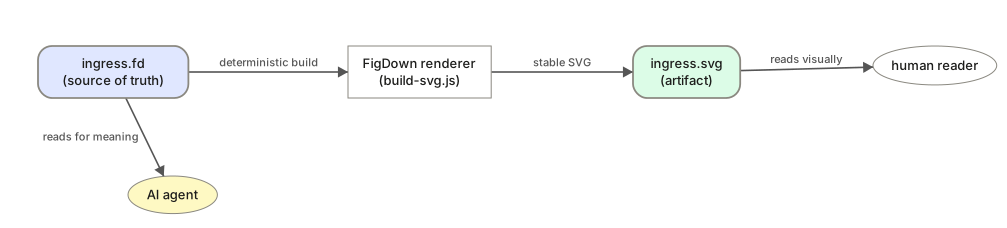
source: [figures/one-source-two-readers.fd](figures/one-source-two-readers.fd) — this figure is FigDown
Think of it as the figure layer of Markdown: what Mermaid did for flowcharts,
extended to the diagram families Mermaid cannot express — annotated block
architectures, protocol headers, lookup tables, packet walks — with **layout
treated as part of the knowledge** rather than as something the renderer is
free to rearrange.
**[Try it live — the editor runs in your browser, no install.](https://figdown.org/editor/figdown.html)**
---
## Fifteen seconds
The figure above is the whole idea, and it is itself a FigDown figure: one
`.fd` is the source of truth, a deterministic renderer turns it into the SVG a
human sees, and an agent reads the same `.fd` directly for meaning.
Here is what that source looks like. This document is
[`examples/dns.fd`](examples/dns.fd) in full — 30 lines, nothing has been
elided.
```figdown
# FigDown — figures as text. Spec: https://github.com/FigDown/figdown
figdown 0.1 bitfield
# DNS Message Header — RFC 1035 §4.1.1
# Each row is 16 bits, MSB-0 numbering (bit 0 at left).
bitfield dns "DNS Message Header (RFC 1035)" word=16 numbering=msb0
# Row 1: Transaction ID
field "ID" 16 description="Identifier assigned by the program that generates the query; copied into the reply"
# Row 2: Flags (QR + Opcode + AA + TC + RD + RA + Z + RCODE = 16 bits)
field QR:1,Opcode:4,AA:1,TC:1,RD:1,RA:1,Z:3,RCODE:4
# Row 3: Question Count
field "QDCOUNT" 16 description="Number of entries in the question section"
# Row 4: Answer Record Count
field "ANCOUNT" 16 description="Number of resource records in the answer section"
# Row 5: Authority Record Count
field "NSCOUNT" 16 description="Number of name server resource records in the authority section"
# Row 6: Additional Record Count
field "ARCOUNT" 16 description="Number of resource records in the additional records section"
# Variable-length sections (one representative row each)
break
field "Question / Answer / Authority / Additional sections" * description="Variable-length sections follow the header; see RFC 1035 §4.1.2–4.1.4"
```
It renders to this, deterministically — same source, same bytes, every time:
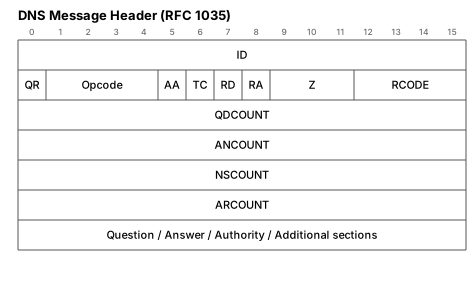
source: [examples/dns.fd](examples/dns.fd) — this figure is FigDown
Look at what the picture had to carry: a bit ruler numbering 0–15 across the
top, and a flags word split into eight sub-byte fields — `QR | Opcode | AA |
TC | RD | RA | Z | RCODE` — drawn at their real widths, four bits for `Opcode`
and one for `AA`. No Markdown-native diagram tool draws that.
An agent handed the text says the same things without the picture: that
`RCODE` is the low four bits of the second 16-bit word, that a DNS header is
six 16-bit words, that what follows it is variable-length and the document
declines to give a width for it. It can say all of it without seeing the
picture. That is the whole idea.
In a Markdown document you embed the artifact and point at the source:
```markdown

source: [examples/dns.fd](examples/dns.fd)
```
The SVG is what humans see; the `source:` footer is what agents follow. Each
generated SVG also embeds its own source text and a SHA-256 of it, so a figure
that gets separated from its `.fd` can always be recovered and reopened.
### One document, several coordinated forms
A `.fd` is not one picture per file. One document can yield several forms that
have to keep agreeing with each other — and a figure is only evidence at a size
where its text can be read, so there is one here, at full width:
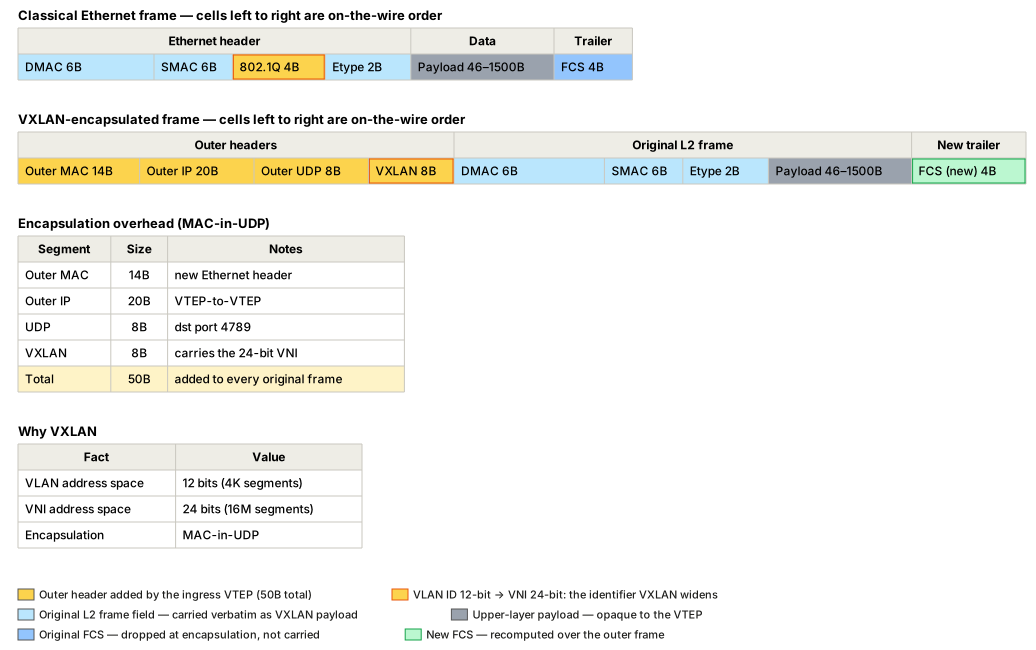
source: [examples/vxlan-encap.fd](examples/vxlan-encap.fd) — the same frame
before and after encapsulation in one document, plus the encapsulation overhead.
The legend is derived from the `class` declarations; nobody drew it.
[`examples/pvlan-flows.fd`](examples/pvlan-flows.fd) goes further and needs its
own page: one document yielding a topology, a derived legend and two rule tables,
because the prohibitions that define a private VLAN cannot be drawn as arrows and
have to be written down. It is 1243×832 with four sub-figures, so it is shown
full size in the [example gallery](examples/index.md) rather than shrunk to fit
here.
---
## Why
Technical documents are full of figures whose **layout carries meaning** —
rank, zones, direction, adjacency. Today that knowledge is trapped in images:
AI agents cannot reliably read it, and hand-maintained diagrams drift from the
text around them.
Existing text-to-diagram tools cover only part of the problem, and none of them
promise the property we consider essential:
> **A small edit to the source must produce a small change in the figure** —
> never a full re-layout that destroys the reader's mental map.
That sentence is the project's reason to exist. A diagram language that
re-flows the whole picture when you rename one node is not a maintenance tool;
it is a generator you run once and then stop touching, which is exactly how
figures come to disagree with the prose beside them.
## Design axioms
These are the beliefs the language is built on. Every ruling in
[`decisions/`](decisions/README.md) traces back to one of them, and they are
listed here rather than buried because a reader who has only the rules cannot
tell a principled decision from an arbitrary one.
1. **Text is the single source of truth.** Figures are build artifacts, 100%
generated from text. No dual maintenance, ever.
2. **Deterministic, program-only rendering.** Same source → same SVG, at the
byte level; **no model in the rendering path**.
3. **Layout stability.** Local edit → local change. Explicitly declared
attributes (position, extent, colour…) are rigid; everything undeclared
adapts automatically, with spillover kept minimal.
4. **Two audiences, one artifact.** An AI agent reads the source block; humans
see the embedded SVG. The standard defines how the two stay paired and in
sync.
5. **Defaults are the common case.** Most figures should need no supplementary
declarations at all — convention over configuration.
6. **A small, closed, token-lean core.** Every line starts with a known
keyword; unknown lines are errors carrying a line number, which is what
powers the AI write → validate → fix loop. Teaching the language to an agent
must fit in a lean prompt. Generic rules over special cases; survey existing
standards before inventing anything.
7. **An editor is mandatory, but every GUI action is a text edit.** Dragging a
node writes a position declaration. The GUI never owns state that the text
cannot express.
8. **Static first; dynamic later.** Dynamic means static plus a discrete
page/step sequence, for algorithm and protocol walkthroughs — not a timeline
animation language.
## Stability — read this before adopting
**FigDown 0.x is a preview, and it is NOT stable.** The language may change
between 0.x versions in ways that require a document to be rewritten. No 0.x
version carries a stability promise, and none should be read as carrying one.
This is stated plainly because the opposite mistake is expensive and quiet: the
project's visible care — a migration log, a conformance suite, the word
*frozen* — invites a reader to infer a stability promise that was never made.
> **"Frozen" is not "stable".**
>
> *Frozen* names the **scope of the change-management promise**, not the
> absence of change. A frozen construct **may still change**. What frozen
> guarantees is *how* it may change: in the same release, the change must ship
> an entry in [`spec/migrations.md`](spec/migrations.md) carrying a
> **mechanical rewrite rule**, a **named diagnostic** so that documents written
> against the old spelling fail loudly instead of silently changing meaning,
> and the matching rewrite in the migration tool.
>
> Anything marked **experimental** may change or be withdrawn with none of
> those three.
So "frozen" is a real guarantee — about *process*, not about *permanence*.
### Two version numbers, and how they are bound
FigDown carries **two** version numbers. Confusing them makes the central
promise unstatable, because "you may stay on a version" has to say *which*
version or it means nothing.
| number | what it versions | where it is written |
|---|---|---|
| **`figdown X.Y`** | the **language** — the document format | the `figdown` header line of every `.fd` file |
| **`vX.Y.Z`** | the **release** — this repository and its engine | the git tag, `package.json`, and every artifact's `data-engine-version` |
**They are bound: `figdown X.Y` is the first two parts of the release version.**
Release `v0.3.2` implements language `figdown 0.3`. The language number has no
third part and never will — a `Z` bump is by definition a change the language
did not make.
| part | meaning |
|---|---|
| **`Z`** | **The language does not move — that is the test, not the size of the change.** No `.fd` document's meaning changes and none needs a rewrite. A `Z` release may add a tool, a document, a non-core profile, a schema, a render option or a gate; none of those is a language construct. `v0.1.1` may fix a rendering defect with **no `.fd` file altered**. |
| **`Y`** | **Features are added. Nothing is ever removed.** Every document a `Y` release accepted, the next one still accepts. |
| **`X`** | **The only point at which support may be removed** — and removing it forces a migration. |
`X` carries the whole removal budget. That is the strict part, and it has a
sharp consequence: **a rename is a removal.** After `v1.0.0` a frozen construct
cannot be renamed within `figdown 1.y` — a rename takes `figdown 2.0`. The
industry-standard deprecate-then-remove cycle is deliberately refused, because
**code is maintained but documents are archived**: a deprecation warning assumes
an author who comes back and runs the thing, and a five-year-old figure has no
such author.
### Three promises, not one
One word — "version" — usually carries all three of these. They are distinct,
and each is worth something on its own:
| promise | what it says | condition |
|---|---|---|
| **Compatible** | the document's **meaning** is preserved; the engine accepts it and renders it correctly | same `X`, engine `Y` ≥ document `y` — **from `v1.0.0` only** |
| **Reproducible** | the **bytes** of the SVG are identical | same source **and** same release version — holds today |
| **Available** | the **archived engine still runs**, so the exact figure is always recoverable | unconditional, from the first release onward |
Two limits are worth stating plainly, because assuming them away is what makes
the archive look redundant when it is not:
- **Compatibility takes force at `v1.0.0`.** During 0.x there is no such
guarantee, and **`figdown 0.1` → `figdown 0.2` is not covered**. The rule is
written now so that it is rehearsed now.
- **Compatible is not byte-identical.** A `Y` bump may legitimately improve
rendering while removing nothing: the meaning is unchanged, the picture may
not be. To recover the exact figure you need the exact engine — which is
precisely why the per-release archive exists.
### What is promised
| | **0.x (today)** | **v1.0 and later** |
|---|---|---|
| Mechanical migration between language versions | **SHOULD** — best effort | **MUST** |
| A document staying on an older declared language version | **MAY** — permitted, not promised | **MUST** be honoured; a rewrite is never forced |
| The archived engine for a release remaining runnable | **MUST** | **MUST** |
The middle row is the compatibility promise above; the bottom row is
availability, and it is the one that does not weaken in 0.x.
Two consequences worth planning around:
- **The archive is the promise that does not weaken.** Every release gets one
tag and one immutable, self-contained engine page. A user who wants to stay
on a language version always can, by running the release that implemented it
— and that does not depend on any future engine still understanding old
documents. For `v0.1.0` that page is
[`archive/0.1/figdown.html`](archive/0.1/figdown.html): open it in any
browser, paste a `figdown 0.1` document in, and it renders exactly as
`v0.1.0` rendered it. The live editor is a tool and tracks the current
state; only the versioned `archive/` path is promised never to change.
- **Expect one migration at `figdown 1.0`, and none after it** — until a
`figdown 2.0`, which is the only place a removal may occur and which arrives
with its own migration.
**Stability begins at v1.0.** The full normative policy is
[`spec/core.md` §13](spec/core.md#13-stability-and-versioning-normative).
---
## Where to go next
Every document below has exactly one reader. Find yourself in the left column
and read that row; you should not need the others.
| If you are… | Read |
|---|---|
| **authoring a figure** | [`guide/authoring.md`](guide/authoring.md) — state the meaning, pick a genre, express it, and know when to stop |
| **an AI agent or a tool reading `.fd`** | [`guide/agents.md`](guide/agents.md), then the reading-agent contract in [`spec/core.md` §12.7](spec/core.md#127-the-reading-agent-contract) — what you may conclude from a document, and what you must not |
| **handed a `.fd` and needing to read it correctly** | [`read/0.1/reading.md`](read/0.1/reading.md) — nothing to install: that file plus the one for the genre on line 1 ([`bitfield.md`](read/0.1/bitfield.md), [`scene.md`](read/0.1/scene.md) for `block`, `topology` and `flowchart`, [`table.md`](read/0.1/table.md), [`layout.md`](read/0.1/layout.md) for arrangement, [`transcribe.md`](read/0.1/transcribe.md) to go the other way). Reading a `bitfield` costs those two files, ~13 KB, against ~335 KB of specification. `0.1` is the language version they describe; a later `read/0.2/` is added beside them and `read/0.1/` does not change. |
| **implementing FigDown** | [`spec/core.md`](spec/core.md) for the normative language, then [`conformance/`](conformance/README.md) — golden fixtures designed to be passed without ever reading the reference engine |
| **evaluating whether to adopt it** | [`guide/showcase.md`](guide/showcase.md) — worked figures, each with its source, what a human sees, what an agent can answer from the text alone, and what the figure still cannot say |
Secondary routes, once you are past the first read:
| | |
|---|---|
| [`guide/expressing.md`](guide/expressing.md) | stuck on one thing mid-document: "I need to show X → use Y", plus what the current language cannot express and the sanctioned interim for each |
| [`guide/layout.md`](guide/layout.md) | the figure parses but does not read well: the escalation ladder and when to stop climbing it |
| [`spec/README.md`](spec/README.md) | what is frozen, what is experimental, and what each promises |
| [`decisions/`](decisions/README.md) | why the language is shaped this way, what was rejected, and what would reopen it |
| [`examples/`](examples/index.md) | specimens to copy — real `.fd` + `.svg` pairs |
| [`skill/`](skill/README.md) | installing FigDown into a coding agent |
| [`tools/`](tools/README.md) | building and checking figures from a command line or in CI |
| [`dist/`](dist/README.md) | embedding the renderer in your own program |
| [`integrations/`](integrations/) | wiring FigDown into a documentation pipeline |
## Install
**Into a coding agent.** The FigDown skill teaches an agent to author, build
and read figures. As a Claude Code plugin:
```sh
/plugin marketplace add FigDown/figdown
/plugin install figdown@figdown
```
Or copy the self-contained bundle into any skills directory, with no plugin
mechanism involved:
```sh
cp -r skill/figdown ~/.claude/skills/figdown
```
Both paths install the same directory — the plugin manifest points at
[`skill/figdown/`](skill/README.md) rather than copying it. See
[`skill/README.md`](skill/README.md) for the project-scoped variant and for
other agent frameworks.
**Into a program or a build.** The renderer is published on npm under the MIT
licence:
```sh
npm install -g figdown
figdown-svg your.fd
```
No network access and no other dependency is needed to render. The browser
editor is a single self-contained HTML file; the CLI needs only Node.js.
## Contributing
Proposals, counter-examples and prior-art pointers are welcome. The registry is
closed by design, so a change arrives fastest when it brings evidence — see
[`.github/CONTRIBUTING.md`](.github/CONTRIBUTING.md) for what a proposal must
carry and how a frozen construct differs from an experimental one.
The most valuable contributions right now are diagram types the standard must
cover (with real samples), existing conventions it should borrow instead of
invent, and attacks on the axioms above — tell us where they break.
Security reports go through [`.github/SECURITY.md`](.github/SECURITY.md), never
a public issue.
## Licence
MIT — see [LICENSE](LICENSE).